Thermal label printers have become an essential tool across logistics, retail, office, and home environments. Thanks to their low operating costs, fast printing speeds, and reliable output quality, thermal printers are widely used for printing shipping labels, barcode labels, and adhesive stickers. In this article, we will explore the key advantages of thermal label printers and their most common applications, helping you understand why they are one of the most cost-effective printing solutions available today.
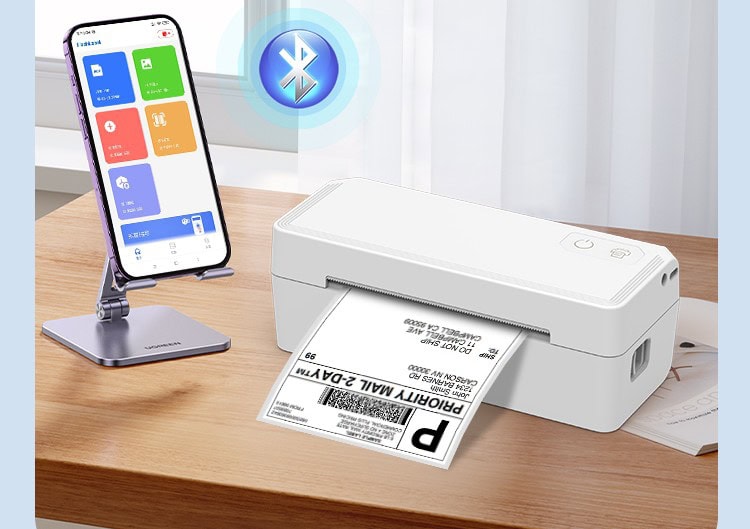
I. What Is a Thermal Label Printer?
A thermal label printer is a type of printer that uses heat to produce images on specially coated thermal paper or labels. Unlike traditional inkjet or laser printers, thermal printers do not require ink or toner. Instead, they rely on heat-sensitive materials, making them simpler, more efficient, and more economical for high-volume label printing tasks.
There are two main types of thermal printing technologies:
① Direct Thermal Printing – Uses heat-sensitive paper, ideal for short-term labels.
② Thermal Transfer Printing – Uses a ribbon to transfer ink onto labels, suitable for long-term durability.
③ This article mainly focuses on thermal (direct thermal) label printers, which are commonly used for shipping labels and adhesive tags.
II. Key Advantages of Thermal Label Printers
1. Low Purchase Cost
One of the biggest advantages of thermal label printers is their affordable price. Compared to laser and inkjet printers, thermal printers typically have a lower upfront cost, making them ideal for small businesses, startups, retail stores, and home users. This low entry barrier allows businesses to quickly adopt professional label printing without a large investment.
2. High Print Quality
Despite their low cost, thermal printers deliver clear and sharp print results. Text, barcodes, QR codes, and graphics are printed with high contrast and accuracy, ensuring easy scanning and readability. This makes thermal label printers especially suitable for logistics, inventory management, and retail labeling where precision is critical.
3. Fast Printing Speed
Thermal label printers are designed for efficiency. They offer fast printing speeds, allowing users to print multiple labels in seconds. This is particularly valuable in high-volume environments such as warehouses and shipping centers, where speed directly impacts productivity and order fulfillment times.
4. Low Consumable Costs
Unlike traditional printers, thermal printers do not require ink or toner, significantly reducing ongoing consumable expenses. The main consumable is thermal label paper, which is generally inexpensive and easy to source. This results in a much lower cost per label, making thermal printers highly cost-effective for daily use.
5. Low Maintenance and Repair Costs
With fewer moving parts and no ink systems, thermal label printers have a simple internal structure. This leads to lower maintenance requirements and reduced risk of mechanical failure. As a result, repair costs are minimal, downtime is reduced, and overall printer lifespan is extended—another major benefit for businesses looking to control operational expenses.
III. Common Applications of Thermal Label Printers
1. Warehouses and Logistics Centers
Thermal label printers are widely used in warehouses and logistics operations to print shipping labels, barcode labels, and inventory tags. Their fast speed and reliable output help streamline picking, packing, and shipping processes while ensuring accurate tracking throughout the supply chain.
2. Offices and Commercial Environments
In offices, thermal printers are used for document labeling, asset management, and file organization. They are compact, quiet, and easy to operate, making them suitable for daily administrative tasks without the noise or complexity of traditional printers.
3. Retail Stores
Retail stores rely on thermal label printers for price tags, product labels, and promotional stickers. The ability to quickly print clear, professional labels improves store efficiency and enhances the overall customer experience.
4. Home Use
With the growth of e-commerce and home businesses, thermal label printers have become increasingly popular for home use. They are ideal for printing shipping labels, address labels, and organization tags, offering a simple and affordable solution for individuals and small online sellers.
5. Printing Shipping Labels and Adhesive Stickers
One of the most common uses of thermal label printers is printing courier waybills, shipping labels, and self-adhesive labels. These labels are essential for express delivery services, online stores, and logistics providers, where durability, readability, and efficiency are crucial.
IV. Why Choose a Thermal Label Printer?
If your business or household requires frequent label printing, a thermal label printer offers unmatched advantages in terms of cost, speed, print quality, and reliability. Whether you operate a warehouse, run a retail store, manage office operations, or ship products from home, thermal printers provide a practical and scalable solution.
Thermal label printers stand out as one of the most efficient and economical printing technologies available today. Their low price, fast printing speed, high print quality, low consumable costs, and minimal maintenance make them ideal for a wide range of applications—from warehouses and offices to retail stores and homes. As demand for shipping labels and adhesive tags continues to grow, thermal label printers will remain a smart and future-proof choice for businesses of all sizes.