Hidden inside your car, your microwave, the factory down the road, and even the medical equipment in a hospital, there exists a different kind of computer. It doesn’t have a monitor, a keyboard, or a generic operating system. It is the embedded computer—a dedicated, specialized machine designed to perform a specific task reliably and efficiently.
In this article, we will explore the true definition of an embedded computer, its core functions, the vast array of its uses, and the fascinating history of how it became the invisible backbone of modern life.
I. What is an Embedded Computer?
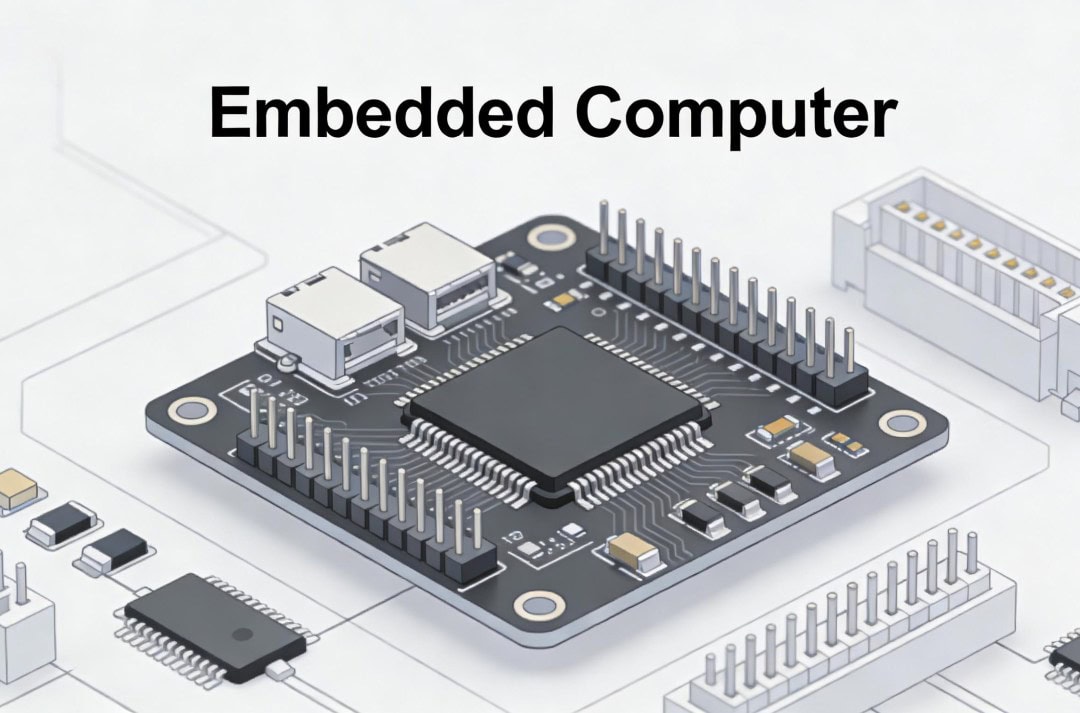
An embedded computer is a specialized computing system that is designed for dedicated control or monitoring of a specific function within a larger mechanical or electrical system. Unlike your personal computer (PC), which is a general-purpose machine capable of running thousands of different applications, an embedded computer is “embedded” into the device it controls.
It is a combination of computer hardware (a microprocessor or microcontroller) and software (firmware) engineered to perform one task, or a small set of related tasks, repeatedly and reliably.
Key Characteristics of an Embedded Computer:
① Task-Specific: It is built to do one thing (e.g., control anti-lock brakes, regulate a thermostat, process a Wi-Fi signal).
② Resource-Constrained: It typically has minimal processing power, memory, and storage compared to a PC, just enough to get its job done efficiently.
③ Low Power Consumption: Many run on batteries or need to dissipate very little heat, making power efficiency critical.
④ Real-Time Operation: Many embedded systems must respond to events in the physical world within a strict timeframe (e.g., deploying an airbag).
⑤ High Reliability and Stability: They are often designed to run for years without crashing or needing a reboot.
II. What Do Embedded Computers Do?
Despite their small size and low profile, embedded computers perform critical functions that can be categorized into three main areas:
1. Monitoring and Sensing: They constantly read data from sensors in their environment. This could be temperature data from a thermostat, accelerometer data from a car, or light levels from a camera system.
2. Control and Actuation: Based on the data they collect, they make decisions and control physical devices. If the room is too cold, the embedded computer in a smart thermostat signals the heater to turn on. If a car skids, the embedded system activates the anti-lock brakes.
3. Processing and Communication: They process raw data into useful information. A digital hearing aid, for example, uses an embedded computer to filter out background noise and amplify speech. They also handle communication protocols, allowing your smartwatch to talk to your phone via Bluetooth.
III. The History of Embedded Computers
The history of the embedded computer is a story of miniaturization, cost reduction, and increasing intelligence. It mirrors the evolution of the semiconductor industry itself.
1. The 1960s: The Birth of Dedicated Systems
The first modern embedded system is widely recognized as the Apollo Guidance Computer (AGC) , developed by MIT Instrumentation Laboratory in the mid-1960s. It was one of the first significant uses of integrated circuits. While massive by today’s standards, it was revolutionary for its time, providing real-time, onboard guidance, navigation, and control for the Apollo spacecraft. This proved that complex computing could be done outside of a massive mainframe room.
2. The 1970s: The Microcontroller Revolution
The true birth of the mass-market embedded computer came in 1971 with the invention of the microprocessor by Intel (the 4004). For the first time, the brains of a computer were available on a single chip.
The game-changer arrived in 1974 when Texas Instruments introduced the TMS 1000, which is considered the first microcontroller. Unlike a simple microprocessor, a microcontroller combined the processor, memory (RAM and ROM), and input/output (I/O) peripherals all on a single chip. This “computer on a chip” was cheap, small, and powerful enough to be embedded into countless products. By the late 1970s, embedded systems were appearing in calculators, traffic lights, and advanced home appliances.
3. The 1980s: The Rise of Real-Time Operating Systems (RTOS)
As the complexity of tasks grew, so did the need for better software. The 1980s saw the widespread adoption of Real-Time Operating Systems (RTOS) like VxWorks and pSOS. These were lightweight software platforms that could manage multiple tasks and guarantee response times. This decade also marked the explosion of embedded computers in consumer electronics, with devices like the first IBM PC (which used embedded controllers for the keyboard and disk drives) and the proliferation of video game consoles.
4. The 1990s: The Networking Era
The rise of the internet and local area networks had a profound effect on embedded systems. The concept of “embedded internet” emerged. Devices were no longer isolated; they could now communicate. Printers became network-aware, industrial controllers were connected for remote monitoring, and the first primitive “smart” home devices began to appear.
5. The 2000s to Present: The Internet of Things (IoT) and Beyond
The 21st century has been defined by the Internet of Things (IoT) . The cost of computing power plummeted, and wireless connectivity (Wi-Fi, Bluetooth, Zigbee) became ubiquitous. This allowed virtually any device to be connected to the internet. Today’s embedded computers are incredibly powerful and efficient. They power smartphones (which are essentially advanced embedded systems), smart TVs, wearables, autonomous drones, and the complex systems inside electric vehicles. The focus has shifted to connectivity, AI at the edge (processing data locally rather than in the cloud), and enhanced security.
IV. Where You’ll Find Embedded Computers Today
The use of embedded computers is virtually limitless. Here are some of the most common and impactful applications:
① Consumer Electronics: Smart TVs, digital watches, GPS devices, smart speakers, and network routers.
② Automotive Systems: Modern cars contain dozens of embedded systems controlling engine management (ECU), cruise control, anti-lock braking systems (ABS), infotainment, and airbags.
③ Medical Devices: Life-critical devices like pacemakers, insulin pumps, defibrillators, and patient monitoring systems rely on highly reliable embedded computers.
④ Industrial Control: Programmable Logic Controllers (PLCs) and robotic arms in factories use embedded systems for automation and precision manufacturing.
⑤ Aerospace and Defense: Avionics, guidance systems in missiles, and control systems in satellites.
⑥ Office Automation: Printers, scanners, and network switches all contain embedded processors.
⑦ Smart Home and IoT: Smart thermostats, security cameras, connected light bulbs, and smart refrigerators.
The embedded computer is the unsung hero of the technological age. From its origins in the space race to its current role powering the Internet of Things, it has continuously evolved to become smaller, smarter, and more connected. While the PC and the smartphone get most of the attention, it is the billions of embedded computers—silently and reliably performing dedicated tasks—that truly run our world. As we move toward a future of autonomous vehicles and smart cities, the importance of these specialized, invisible computers will only continue to grow.